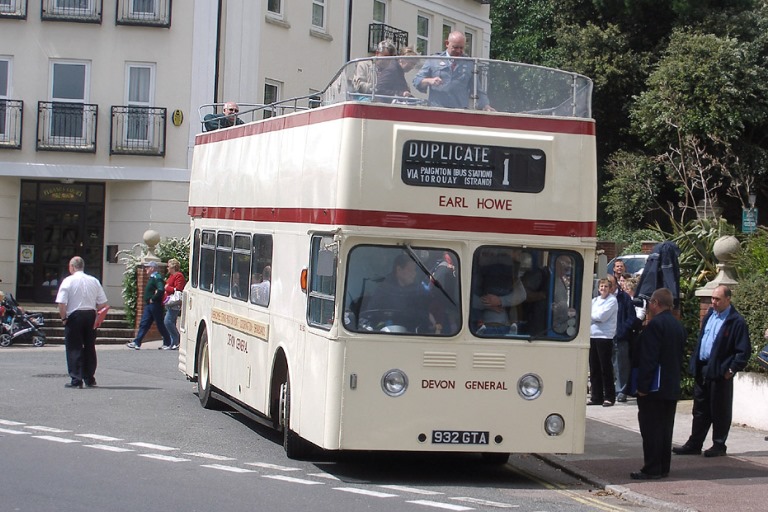
Leyland Atlantean - 932GTA - Vehicle History
932 is an example of a 1961 Convertible 'Open Top' Atlantean. Devon General had operated open top vehicles in and around Torquay since 1955 and the Atlanteans were purchased during 1961 as replacements for ageing half-cab varieties. The 9 Atlanteans introduced were named after various seafarers and quickly became known as the 'Sea Dog' Atlanteans. They were considered revolutionary in their day as they were amongst the first vehicles with detachable roofs, enabling them to be used throughout the year
Dates |
History
|
|
1 June 1961 |
Date of First Registration by Devon General Omnibus and
Touring Co Ltd |
|
1 January 1971 |
Transferred to ownership of Western National Omnibus
Company Ltd upon takeover of Devon General |
|
1972 |
Re-painted into NBC Poppy Red livery with additional
white between the decks |
|
July 1980 |
Re-painted into NBC Poppy Red with Unibus advert for
Rainbow House Hotel, Torquay |
|
1 January 1983 |
Transferred to Devon General Ltd upon split of Western
National into four new companies |
|
July 1983 |
Withdrawn from service |
|
2 September 1983 |
Acquired by East Yorkshire Motor Services, Hull and
allocated fleet number 904. Painted in
two-tone blue and white NBC ‘Venetian Blind’ livery, allocated to
Bridlington and named ‘Belvedere Star’ |
|
1987 |
Re-numbered 632 by East Yorkshire |
|
9 August 1989 |
Acquired by Bob Follwell, Stableford |
|
2 January 1991 |
First MOT in private ownership (?) |
|
2 May 1991 |
Tachograph installed |
|
28 April 2011 |
Class VI MOT gained ahead of operation by Midland
Heritage Bus Co Ltd (mainly for wedding hires) |
|
29 April 2014 |
Class VI MOT expiry |
|
3 May 2014 |
Acquired by Dave Wright, Stoke-on-Trent |
|
7 December 2014 |
Acquired by Terry Bennett, Sherborne |
Technical Data:
Earl Howe:
Admiral
of the Fleet, Richard Howe, 1st Earl Howe, KG (8 March 1726 – 5 August
1799)
was a British naval officer, notable in particular for his service
during the
American War of Independence and French Revolutionary Wars. He
was the brother of William and George Howe. Howe joined the navy
at the age of thirteen
and served throughout the War of the Austrian Succession. During the
Seven
Years' War he gained a reputation for his role in amphibious operations
against
the French coast as part of Britain's policy of naval descents. He took
part in
the decisive British naval victory at the Battle of Quiberon Bay in
1759. He is
best known for his service during the American War of Independence,
when he
acted as a naval commander and a peace commissioner with the American
rebels,
and for his command of the British fleet during the Glorious First of
June in
1794.
This Web Page Created with PageBreeze Free HTML Editor